Earning the 12 Eagle-Required Merit Badges

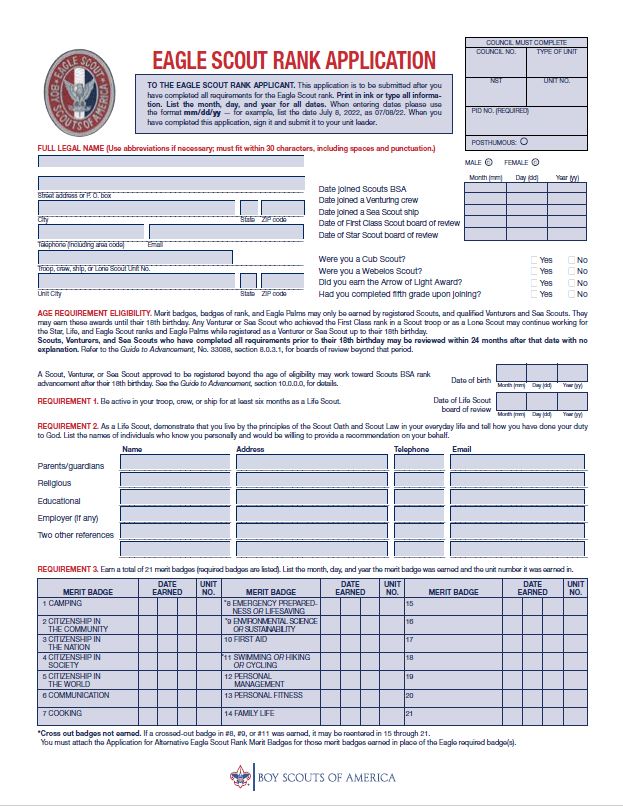
Of the 21 merit badges that a Scout must earn before achieving the rank of Eagle Scout, 12 are required.  That means only 9 of the 21 merit badges are elective.  If you are a Scout that intends to earn Eagle Rank, then it is a good idea to concentrate on the twelve Eagle-Required merit badges starting early in your Scouting career.  The electives will fall into place as you attend summer camp or perhaps other events.  So, keep focused on these important 12 Eagle-required merit badges and not the electives.

Let’s talk about those 12 merit badges, and perhaps the best time and place to earn them.

Swimming, Environmental Science, Communications, First Aid, Lifesaving:  No better place than summer camp.  If you are a swimmer, you will be passing a swimming test your first day at camp.  Might as well keep going and get the Swimming merit badge!  (If you are not a swimmer, this is absolutely the best place to learn.  I taught swimming to non-swimmers as a lifeguard at a Scout camp many years ago.  I had every boy swimming within a week.)  Many camps have an age limit for Lifesaving, so this might be delayed until your third or fourth season at summer camp.  There are alternatives for Swimming and Lifesaving, but I personally recommend these two merit badges.  I believe that every person should know how to swim, and also how to rescue someone in the water.  Environmental Science, First Aid and Communications are also a natural for camp, and all three should be earned early on your advancement trail.  Not a bad idea to use four of these merit badges for your Star advancement.

Family Life is a merit badge that should be earned as young Scout.  It is fairly easy, requiring a couple of family projects and a family meeting.  (This is one of the “90-day” merit badges.  You must keep a record of your chores for 90 days, so there is no way to earn the merit badge in less than that time.  If you are seventeen years old and have not earned this merit badge, you MUST start the merit badge at least three months before your 18th birthday, or you will not be able to earn Eagle Rank.)

Citizenship in the Community, Citizenship in the Nation, and Citizenship in the World:  Citizenship in the Community is a complex merit badge, requiring an interview of a public official, attendance at school or town board meeting, and eight hours of community service to an organization that you have identified and interviewed.  Citizenship in the Nation is easier, requiring only one trip, but requires a reasonable knowledge of our government and how it works.  Citizenship in the World is what I call a “homework” merit badge.  You can earn the entire merit badge by reading the merit badge pamphlet and answering the questions.  (I had one Scout earn this merit badge in one 35-minute session with me.  He was a history buff and really knew his material.)  All three citizenship merit badges can be earned at any age, but they are probably easier for a Scout of 13 years or older.

Camping:  You will earn this over the course of several years camping with your troop.  A total of 20 nights of camping are required, only 7 of which may be summer camp.  Keep good track of all your camping trips in your Scout handbook!

Personal Fitness and Personal Management:  These two merit badges are the most important ones for launching yourself into adulthood, and should be the last Eagle-required merit badges earned.  They are “real world” and require a lot of work.  And they are also the two other “90-day” merit badges, requiring a log of personal fitness activities and a journal of income and expenses for 3 months.

You can download the workbooks for all these merit badges on this website.  Go to the “Merit Badge” tab at the top, click “12 Eagle Required Merit Badges”, and then scroll down the the merit badge you want to click and download the workbook.


My Moon Shot

I felt a real sadness when Eagle Scout Neil Armstrong died a few days ago.  My own Scouting career coincided with the “space race” decade of the 1960′s, and I lived in Huntsville, Alabama, home of the George C. Marshall Space Flight Center.  To me, Neil Armstrong was the epitome of what it is to be an Eagle Scout.  I would like to pass along the following story of a Scout who persuades Mr. Armstrong to become his Space Exploration merit badge counselor.   The story, “My Moon Shot”, speaks volumes about Neil Armstrong’s grace and humility.

http://www.americanheritage.com/content/my-moon-shot

The Two Most Important Merit Badges

As an Eagle Coach, I am concerned with helping young men attain Eagle Scout rank.  But I am actually more concerned with helping them establish a good base for launching themselves into the business of leading a productive life as an adult.  To help achieve that objective, there are two no more important merit badges than Personal Fitness and Personal Management.  These are the cornerstones of living a full life in accordance with the Scout Law and Oath.  If we cannot take care of ourselves, how are we to take care of others?

Almost everyone has been on an airplane flight, where a flight attendant demonstrates the correct use of an oxygen mask in the event of cabin depressurization.   Their instructions  to put your own mask on first, and then the masks of children, sounds counter-intuitive.  But the logic is sound:  If you pass out, how are you going to help your children?

Likewise, if you cannot get your own act together, how are you going to fulfill that part of our oath that says you will help other people at all times?  Personal Fitness and Personal Management give you the tools to do just that.  Scouts, as you complete these merit badges on your Eagle trail, try to go beyond the letter of the requirements and ask yourself how you can implement what you are learning into your life today, as well as the rest of your life.

Both of these merit badges are best taken later in your Scout career, as you get closer to a life beyond living with your parents or guardians.  And here’s a shortcut:  If you complete your Eagle Service Project proposal before you start Personal Management, your merit badge counselor can count it as fulfillment of requirement # 9, a project on paper.  One of those cases where your work can count twice!

A Century of Eagle Scouts

Michael Malone: A Century of Eagle Scouts

The Eagles’ service project is the single greatest youth-service initiative in history, and one that has touched every community in America in an important way.

By Michael S. Malone

Mr. Malone, a veteran journalist and Eagle Scout, is the author of a new history of Eagle Scouting, “Four Percent” (WindRush Publishing, 2012).

A version of this article appeared August 1, 2012, on page A13 in the U.S. edition of The Wall Street Journal, with the headline: A Century of Eagle Scouts.

http://online.wsj.com/article/SB10001424052702303933704577533561616246168.html

One hundred years ago on Aug. 1, Arthur Eldred, a 17-year-old Boy Scout from Long Island, became the first person to earn the Eagle Scout rank. Eldred, tall, quiet and with a shock of dark hair, had joined scouting largely at the behest of his widowed mother, who hoped it would give some structure to his life. Yet as Eagle Scouts would continue to do throughout the next century, Eldred caught the scouting world by surprise. He was the first of an extraordinary new cohort of young men who were to prove very different from the classic 13-year-old Boy Scout in short pants.

Eldred’s initial accomplishment was to complete the requirements for the rank of Eagle Scout only six months after that supreme award in American scouting was announced in April 1912. The leaders of the Boy Scouts of America (BSA), assuming it would take several years for any boy to earn the required 21 merit badges, hadn’t yet devised a final review system for Eagle candidates; they hadn’t even settled on a design for the medal.

Unsure how to proceed after Eldred qualified for all the badges, the BSA ordered him to come down to its headquarters in Manhattan and put him through what had to be the most intimidating board of review in scouting history—led by the BSA’s founders themselves. Eldred apparently passed with ease. And then, as an indication of what kind of remarkable person scouting would now have, while awaiting his award that summer Eldred saved two of his fellow Scouts from drowning.

Out of the more than 115 million boys who have passed through the Boy Scouts of America in the last 102 years, approximately two million have become Eagle Scouts, a 2% rate that has climbed to about 4% of all scouts in recent years. Some may have excelled in outdoor challenges and troop leadership, or while earning merit badges for oceanography and entrepreneurship. Yet all have been changed by the experience of what has been come to be called “the Ph.D. of Boyhood.” And these Eagles in turn have changed the face of American culture in ways both obvious and unexpected.

Many went on to notable careers and distinguished service to the country. The list of famous Eagles over the last century includes movie and television stars, six Medal of Honor recipients, Nobel Prize winners, novelists, a number of astronauts (including most Shuttle astronauts), Tuskegee airmen and Japanese-American internees, congressmen, senators and governors, an endless number of corporate CEOs and university presidents, a U.S. president (Gerald Ford), and the first man to walk on the moon (Neil Armstrong). But there are other, perhaps less obvious, Eagles as well: sexologist Alfred Kinsley, Scientology founder L. Ron Hubbard and Washington’s disgraced ex-mayor Marion Barry.

Two summers ago, during the BSA centennial parade in Washington, D.C., the adult Eagle contingent of official marchers featured a diplomat, a journalist, military officers, a bomb-demolition expert, doctors and a department-store Santa Claus. Despite what you might think, America’s Eagles are spread across the political spectrum. They include individuals across all races (scouting was officially integrated from the start) who hold beliefs as diverse as other Americans. What they have in common is that they chose a life of achievement and assumed leadership roles at a very young age.

Scouting as a whole has regularly (and falsely) suffered the indignities of various stereotypes: the ardent escorts of little old ladies crossing the street, the secret paramilitary militia, the synecdoche of all things reactionary.

Yet the image of Eagle Scouts has only risen over the decades in American life and culture—Indiana Jones, like Steven Spielberg, is an Eagle Scout, and so is Will Smith’s character in “Men in Black.” It is as close to a gold standard of youth as we have, which is why it is regularly noted in the obituaries of octogenarians alongside a lifetime list of other achievements.

And that reputation is deserved. A recent Gallup survey (for Baylor University) of Eagle Scouts, former Boy Scouts and men who never joined scouting found that America’s Eagles are far more engaged with the world around them in almost every way—in community service, club membership, churchgoing, outdoor recreation, and the fields of education and health.

Eagle Scouting’s biggest contribution to American life is the one most recognized: the service project, the “dissertation” of the boyhood Ph.D. Since the mid-1960s, all Eagle candidates are required, beyond earning the traditional 21 merit badges, to devise, plan, execute and manage a community-service project.

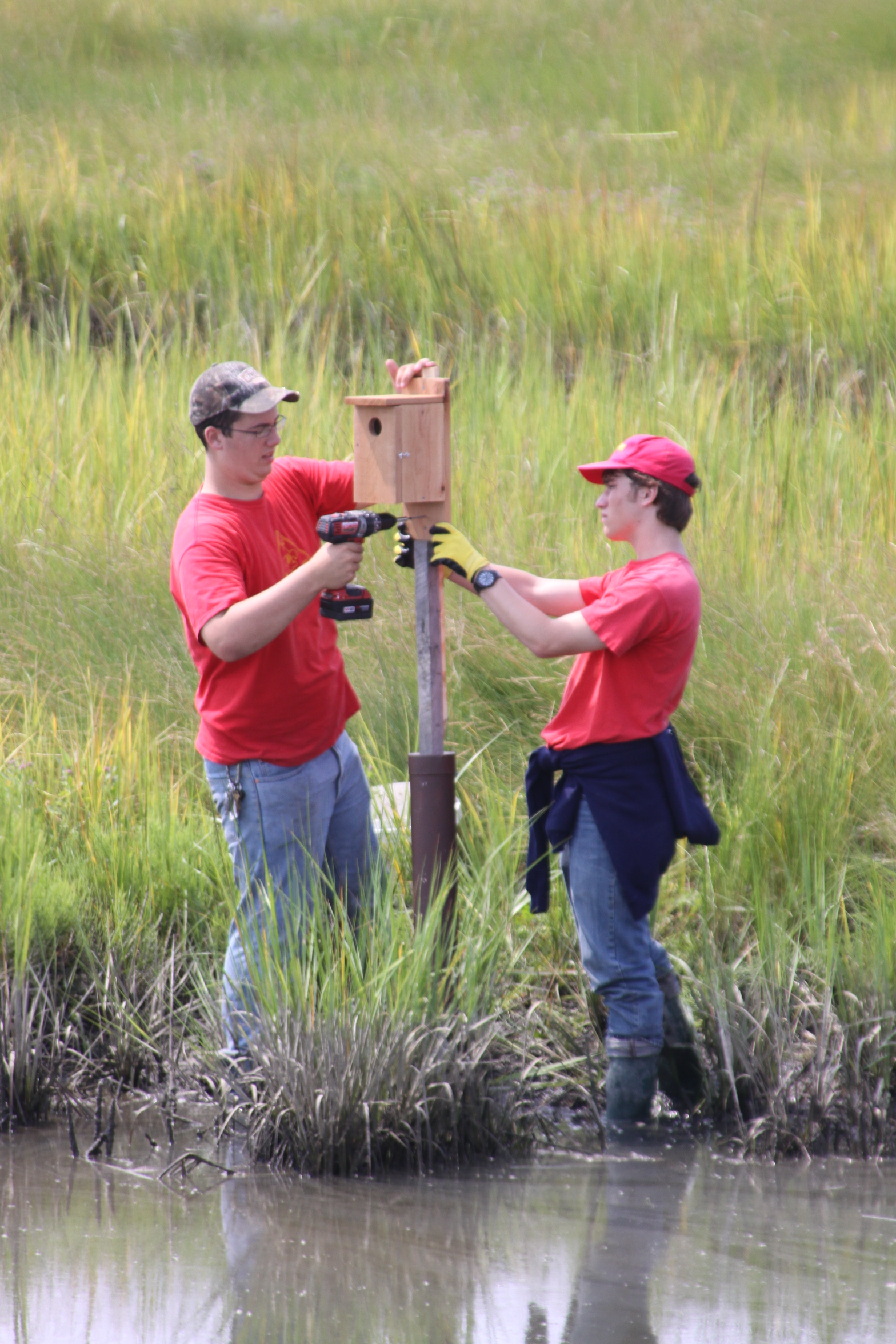
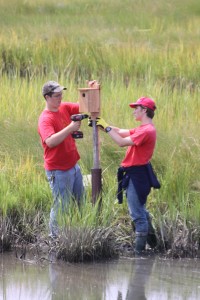
Most of these projects are small: a new bench at the park, painting a school building, collecting blankets for a homeless shelter. But some are hugely ambitious: restoring wetlands, building a library in Africa or a playground at a Russian orphanage, creating an artificial reef—and they consume thousands of hours.

You cannot read a small-town newspaper in America without running across the story of an Eagle service project at least once a month. But it was only recently that the National Eagle Scout Association decided to look beyond the anecdotal and tally up all of the Eagle service projects ever done. It came to the jaw-dropping total of more than 100 million hours of service. Eagle Scouts are adding more than three million more hours each year.

Those numbers likely make the Eagle Scout service project the single greatest youth service initiative in history, and one that has touched every community in America in an important way.

Wear your uniform.

Scouts, as you work on your project you are going to interact with many people.  That is one of the major objectives of the Eagle Service Project – for you to demonstrate leadership and your ability to work with people.  EVERYONE will take you more seriously when you wear your uniform.  As you will discover when you become an Eagle Scout, the accomplishment is nearly universally admired.  When you are in uniform, people will go out of their way to help you (and in the process usually tell you stories about their son, brother or father who became an Eagle Scout, or just missed!)

I can tell you that as an Eagle Coach and merit badge counselor, I know that I have a serious and motivated Scout when he comes to a meeting with me dressed in his Scout uniform.  I like to work with serious and motivated people, and will usually go the extra mile to assist them.  That is just human nature. Doors will open for you when you appear in uniform with your Eagle Scout Service Project proposal in hand!

So put this tool to work for you in all your Eagle Service project meetings, especially those meetings where you are asking for help or donations!  You don’t need to wear your merit badge sash or every last patch, but your uniform should be neat and clean, shirt tucked in, with presentable shoes.  As a future Eagle Scout, you are taking pride in who your are and what you stand for.  The Scout uniform demonstrates that to the world.

2,151,024 Eagle Scouts!

This graphic is very interesting.  Among other things, the average age of attaining Eagle has risen from 14.6 years old in 1949 to 17.1 years old today.  Almost certainly due to the complexity of the Eagle Service Project today, which was not even required in 1949!

Click on the graphic to download a PDF copy.

Research Finds Eagle Scouts Have Positive, Lasting Influence on American Society

A new study by a major university shows that Eagle Scouts have a positive, lasting influence on American society.   Probably not a surprise to anyone who is visiting this web site!  The following is a summary of their findings.  (The entire report can be downloaded from the download page on this website, or here.)

Research Finds Eagle Scouts Have Positive, Lasting Influence on American Society

Released: 4/10/2012 2:20 PM EDT
Source: Baylor University

Nationwide study shows those who attain Scouting’s highest rank enhance youth’s values, ethics, decision making, relationships and personal development

Newswise — WACO, Texas (April 10, 2012) – One hundred years after Arthur Eldred of New York earned the first Eagle Scout Award from the Boy Scouts of America, researchers with Baylor University’s Institute for Studies of Religion (ISR) and Program on Prosocial Behavior have released findings from a nationwide, scientific survey that demonstrates the significant, positive impact Eagle Scouts have on society – from holding leadership positions in their workplace and neighborhood to voting, giving and volunteering to protecting the environment and being prepared for emergencies.

“There is no shortage of examples or anecdotal accounts that suggest Scouting produces better citizens, but now there is scientific evidence to confirm the prosocial benefits of Scouting or earning the rank of Eagle Scout,” said the study’s principal investigator, Byron R. Johnson, Ph.D., Distinguished Professor of the Social Sciences, director of the Program on Prosocial Behavior and ISR co-director. “The central question of this study was to determine if achieving the rank of Eagle Scout is associated with prosocial behavior and development of character that carries over into young adulthood and beyond.”

With funding from a major two-year research grant from the John Templeton Foundation, Baylor researchers with ISR’s Program on Prosocial Behavior partnered with the Gallup Organization to conduct a nationwide random survey of 2,512 adult males.

Sung Joon Jang, Ph.D., associate professor of sociology, Baylor ISR Faculty Fellow and co-principal investigator, said analyses were conducted to see whether three groups of survey respondents – Eagle Scouts, Scouts who did not achieve the Eagle Scout rank, and non-Scouts – differed in responses to a series of survey questions related to the following topics:
• Well-being (survey questions dedicated to recreational activities, emotional well-being, relational well-being and physical well-being)
• Civic engagement (survey items focusing on membership in formal and informal groups, community donations, community volunteering, community problem-solving, environmental stewardship, political participation and civic leadership)
• Character development (survey statements asking about commitment to learning, goal orientation, planning/preparedness, self-efficacy, activities with neighbors, accountability, moral attitudes, openness to diversity, civic attitudes and spirituality)

The Baylor study found that Eagle Scouts – compared to Scouts who never attained the rank of Eagle Scout and men who were never Scouts – were significantly more likely to:
• Exhibit higher levels of participation in a variety of health and recreational activities, such as regular exercise, outdoor recreation, attending plays and live theater, reading books, playing a musical instrument and visiting a local, state or national park (Figures 1-10, pp. 4-9),
• Show a greater connection to siblings, neighbors, religious community, friends, coworkers, formal and informal groups and a spiritual presence in nature (Figures 11-18, pp. 9-13),
• Share a greater belief in duty to God, service to others, service to the community and leadership, such as donating money within the last month to a religious or non-religious organization or charity, reporting volunteer time with a religious or non-religious organizations, working with neighbors to address a problem or improve something, voting in the last presidential election and holding leadership positions at a workplace or local community (Figures 19-26, pp. 13-17),
• Engage in behaviors that are designed to enhance and protect the environment, such as being active in a group that works to protect the environment, avoiding the use of certain products that harm the environment and using less water in their households (Figures 27-29, pp. 17-18),
• Be committed to setting and achieving personal, professional, spiritual and financial goals (Figures 30-35, pp. 18-21),
• Show higher levels of planning and preparedness, such as having a disaster supply kit in their home and emergency supplies in their car, designating a specific meeting place for family during an emergency and being CPR certified (Figures 36-39, pp. 22-23), and
• Indicate that they have built character traits related to work ethics, morality, tolerance and respect for diversity, such as always exceeding people’s expectations and doing what is right, working hard to get ahead, treating people of other religions with respect, strongly agreeing that most religions make a positive contribution to society, stating that respecting religious leaders outside of their religions is somewhat important and showing respect to the American flag (Figures 40-46, pp. 24-27).

Young-Il Kim, Ph.D., a Post-Doctoral Research Fellow at ISR and study co-author, found that “Eagle Scouts consistently indicate their experience in Scouting contributed to positive and prosocial development.”

“Compared to Scouts and non-Scouts, Eagle Scouts exhibit significantly higher levels of health and recreation, connection, service and leadership, environmental stewardship, goal orientation, planning and preparedness, and character,” said Rodney Stark, Ph.D., Distinguished Professor of the Social Sciences at Baylor and co-director of ISR.


Get organized!

Scouts, your Eagle project will go much smoother and faster if you organize your materials from the very start.  Get into the practice of keeping all your associated materials in one place – this can be a notebook, a file box or a brief case of some kind.  As you do your work, whether it is internet research, meeting with your coach, talking with your beneficiary, or pricing items at the local lumber store, keep your notes in a spiral bound notebook.  If you date your entries, you will have a very comprehensive log and notes all in one place.  Parents, you can really help your Scout by helping him buy organizational tools like this.

You are going to be submitting a paper proposal, not an electronic one.  So here’s another tip.  Buy a report cover on day one, and then insert a blank Eagle Service Project Workbook (you can strip out the informational pages.)  As you fill out your proposal on the computer, insert the completed printed page and remove the blank one in your report cover.  Also insert your “before” photographs, plans, and any other support materials.   Slowly but surely your proposal will grow before you!  The blank pages will remind you what has to be done, and the completed pages will give you a feeling of accomplishment.

And as long as we are talking about getting organized, make sure that you keep all your merit badge cards, awards, and other Boy Scout materials in one place.  While National does have transcript of all your achievements, it is not unusual for awards to be lost or misfiled.  It happens at least once a year in our troop.  This usually means that there is a mad scramble to try to find the original document, which is most often a lost blue card that was never submitted.  If everything is kept in one place, you can simply pull out your copy to verify your award.  Not to mention that it will be easy to set up your display of awards at your Eagle Scout Court of Honor!

As an Eagle Coach, I see a big difference between boys who are organized and those who are not.  When a Scout forgets to bring half of his materials to a meeting, it forces us to delay a discussion on those items until the next meeting, thus dragging out the process.  So get yourself organized and cut some serious hours from the time required to finish your Eagle project!

Eagle Scout Service Project Workbook – Improved MS Word Document Version

The MS Word Document version of the Eagle Scout Service Project Workbook has been improved. If you have been wrestling with formatting and pages with the prior version, please download the up-to-date version in the Downloads section of this website. This version will allow each section to expand as you write additional copy, instead of shrinking the font size in the PDF version.

Scouts, you do not have to submit an electronic version of the workbook! So if you have a page fully complete, print it out and insert it in the project folder that you will eventually submit with your Eagle Scout application. You are also allow to attach additional sheets. So for example, if you want to submit your materials list in the form of an Excel spreadsheet, simply write in the workbook under the section labeled materials, “See attached.” Then insert a printed copy of your Excel spreadsheet immediately behind that page.

You are Entitled to a Board of Review

If a Scout believes that he has completed all the requirements for a rank, he cannot be denied a Board of Review.  BSA is solidly behind this in the new 2011 Guide to Advancement.  Section 8.0.0.2, “Boards of Review Must Be Granted When Requirements are Met” clearly spells this out.  BSA expects that boards will be scheduled at least monthly, and explicitly says that a unit leader does “not have the authority to expect a boy to request one, or to “defer” him, or ask him to perform beyond the requirements in order to be granted one.”

In other words, you cannot be denied a board of review because a leader says that you are “not mature enough”, you missed an outing or you have not done other tasks that have nothing to do with the specific rank requirements.

So, if you feel that you have met all the requirements for rank advancement, ask for the board.  If you are refused, it is time for you or your parents or guardians to speak with the local District Advancement Chair.  If you do not know who that is, call your Council and ask!